In this series of blog posts, I will be sharing the English translation of Yaksha Country (夜叉國), a tale from Strange Stories from a Chinese Studio (聊齋誌異) by Pu Songling (蒲松齡). I have translated this story from the original classical Chinese text. However, please remember that no translation is perfect, especially when it comes to translating classical Chinese. I hope that this will be a fun and informative read.
But first, here is some general information about the story:
Strange Stories from a Chinese Studio dates back to the Qing dynasty (1644-1911). It is said that these stories were written no earlier than the late 1600s. The Yaksha are a benevolent nature spirit originating from Hindu and Buddhist mythology. However, in this story, they are depicted as a rather gruesome and inhuman creature that lives in caves and feds upon raw meat.
Yaksha Country is a strange story. The themes of this story is simply accumulated by the fear of people outside one’s own ethnicity. It encounters the anthropological themes of ethnocentrism and cultural conflict as well as the the psychology of reciprocity and establishing rapport with an “unknown” cave dwelling humanoid species. Thus, this story offers both readers and sinologists alike a historical and anthropological glimpse into how the Manchu ethnic group were regarded by the Han Chinese during the later 1600s. Translation notes are discussed below.
Translation:
夜叉國
Yaksha Country
交州徐姓,泛海为贾。忽被大风吹去。开眼至一处,深山苍莽。冀有居人,遂缆船而登,负糗腊焉。
方入,见两崖皆洞口,密如蜂房;内隐有人声。
In the state of Jiao, there was a man named Xu, who was a merchant.
All of the sudden, a strong wind had swept Xu and his boat away. Upon opening his eyes, Xu appeared to have found himself in an unfamiliar place, that was located deep in the mountainous region that stretched boundlessly across the land. Xu hoped that this place had inhabitants. So, he moored his boat and mounted himself ashore, carrying all of his dried food rations along with him. Upon arrival to this strange new place, Xu came across two cliffs where each and every cave entrance was as densely compacted like honeycomb; within the cave, Xu heard the echo of people.
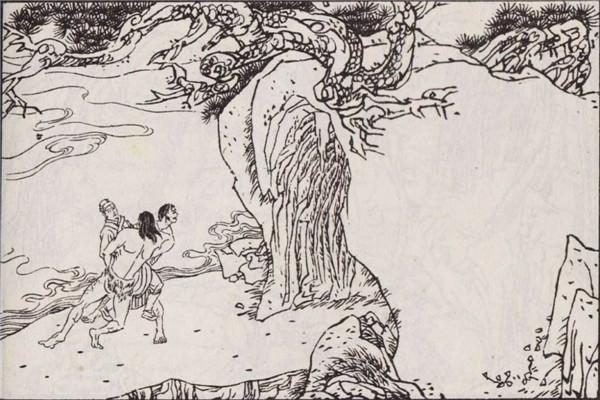
至洞外,伫足一窥,中有夜叉二,牙森列戟,目闪双灯,爪劈生鹿而食。惊散魂魄,急欲奔下;则夜叉已顾见之,辍食执入。
Upon arriving outside the cave’s entrance, Xu stood on his feet and peeped into the cave. Inside the cave, there were two Yakshas with teeth densely lined up like spears and eyes flashing like lantern. Their claws ripping into the flesh of a deer to eat. Xu was so frightened that his soul left his body at that very moment. Xu, then, anxiously desired to hurry back to his boat; but the Yakshas had already seen him by then. They stopped eating and dragged him into the cave.
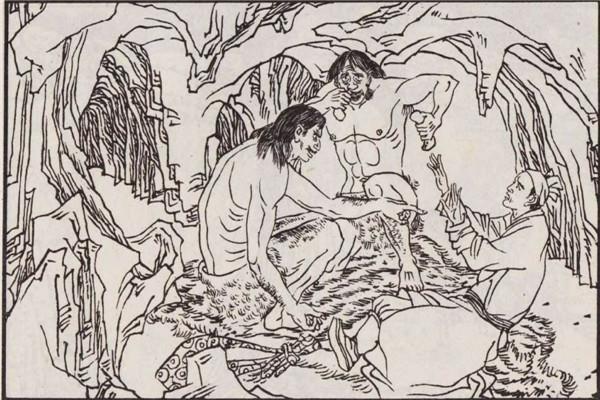
二物相语,如鸟兽鸣,争裂徐衣,似欲啖噉。徐大惧,取橐中糗糒,并牛脯进之。分啖甚美。复翻徐橐。徐摇手以示其无。夜叉怒,又执之。徐哀之曰:“释我。我舟中有釜甑,可烹饪。”夜叉不解其语,仍怒。徐再与手语,夜叉似微解。从至舟,取具入洞,束薪燃火,煮其残鹿,熟而献之。二物噉之喜。夜以巨石杜门,似恐徐遁。徐曲体遥卧,深惧不免。天明,二物出,又杜之。少顷,携一鹿来付徐。徐剥革,于深洞处流水,汲煮数釜。俄有数夜叉至,群集吞噉讫,共指釜,似嫌其小。
The two things appeared to be speaking to each other, but speaking with sounds like the cries of birds and beasts. They stripped Xu of his clothes as if they wished to eat him. Xu was so frightened that he fetched from his bag his dry rations and presented it to them. The Yakshas consumed all the rations until they were satisfied. When they flipped and turned his bag over, Xu had to wave his hand to show that the bag was empty. The Yakshas became angry and grabbed him. Xu, trembling with fright, said: “Let me go. My boat has pots and pans that can be used to cook with.” The Yakshas could not understand anything he said and were, at that point, still provoked by him. Xu used his hands to speak and the Yakshas slightly understood what he was signaling. Arriving at the boat, Xu grabbed his belongings and was taken back into the cave. He used fuel to ignite a fire to cook the spoiled deer and presented it to them. The two things (Yakshas) ate it all up happily. Then, the Yakshas used a large stone to block the entrance of the cave to prevent Xu from escaping. Xu crouched deep into his body to avoid being noticed.
Morning came and the two things (Yakshas) left and blocked the cave entrance again. Shortly after, they brought a deer over to Xu to cook. Xu skinned and gutted the deer and then went deeper into the cave to where running water resides and drew the water into several pots to boil for cooking. Soon, several Yakshas arrived. They flocked together to eat and pointed at the pot as though it were too small.
过三四日,一夜叉负一大釜来,似人所常用者。于是群夜叉各致狼糜。既熟,呼徐同噉。居数日,夜叉渐与徐熟,出亦不施禁锢,聚处如家人。徐渐能察声知意,辄效其音,为夜叉语。夜叉益悦,携一雌来妻徐。徐初畏惧,莫敢伸;雌自开其股就徐,徐乃与交。雌大欢悦。每留肉饵徐,若琴瑟之好。一日,诸夜叉早起,项下各挂明珠一串,更番出门,若伺贵客状。命徐多煮肉。徐以问雌,雌云:“此天寿节。”雌出谓众夜叉曰:“徐郎无骨突子。”众各摘其五,并付雌;雌又自解十枚;共得五十之数,以野苎为绳,穿挂徐项。徐视之,一珠可直百十金。俄顷俱出。徐煮肉毕,雌来邀去,云:“接天王。”至一大洞,广阔数亩。中有石,滑平如几;四围俱有石座;上一座蒙一豹革,余皆以鹿。夜叉二三十辈,列坐满中。
After three to four days passed, one Yaksha brought over a large pot, a pot that all common people like to use. Soon after, a flock of Yakshas brought in a wolf and a deer to cook. After the meat finished cooking, the Yakshas called for Xu to eat with them. Several days later, the Yaksha’s gradually grew used to Xu and comfortably left the cave without needing to block the entrance to prevent his escape. They all lived together like family. Xu gradually understood and learned their ways and could even imitate their sounds to make into the Yaksha language. The Yakshas were pleased and brought forth a female to marry Xu. Xu at first didn’t dare to touch her so the female had to go to Xu herself where they both engaged in intercourse. The female was filled with happiness and every day she left food to lure Xu. Their marital harmony seemed to be good.
One day, all of the Yakshas arose early and upon the neck of every Yaksha hung a string of pearls, where they all, in turns, left as if they were waiting for a special person. The Yakshas then, ordered Xu to cook a lot of meat. Xu asked the female about it and the female said: “This is the day of our ruler’s birthday.” The female left and addressed the other Yakshas saying: “ Xu doesn’t have a string of beads.” Each other the Yakshas plucked five beads from their strings and handed them over to the female who took off ten beads from hers, altogether making fifty beads in number. She used wild grasses for a rope to thread the beads on and hung it upon Xu’s neck. Xu looked at the necklace and realized that one pearl can be worth up to ten hundred gold pieces. In a flash, all of the Yakshas left. Xu finished cooking the meat and the female came back in to invite him to join the celebration by saying: “ Let’s go receive the king.”
After arriving at a large cave that was wide and vast with the middle having a stone that is smooth and level like a table; around the four corners has stones for chairs. One chair, covered with leopard hide while the others are covered with deer hide. There were 20 to 30 generations of Yakshas, lined up and sitting in the packed cave.
To be continued…
Translation notes:
- Throughout the story, you will notice changes in word choice when our main character Xu describes his Yaksha wife as “the female” or 雌 (cí). You will find out that there is no name for the Xu’s Yaksha wife in this story. Xu also used the word “thing” or 物 (wù) to describe Yaksha king and other Yakshas.
- In this story, the Yaksha “entity” was written in a way to reflect the Manchu presence in China during the Qing dynasty. The Yakshas are described as a kind of creature that look nothing like the Chinese. They speak only with bird and animal sounds, eat only meat, and are fierce. Throughout the story, you will continue to encounter a breadcrumb trail of the word Manchu tossed around here and there that will later unfold into a greater story plot and ending.
I hope you enjoyed my translation. Stay tuned for more translations of Yaksha Country!
Cheers,
The Wandering Ghost
 Tales of a Wandering Ghost