Монгольская Народная Сказка
A Mongolian Folktale
蒙古民间传说
This Mongolian folktale is about a lone turtle who was cast away onto unknown land by a vicious storm in the sea. The turtle then met with a blind frog who lived in a well. A frog who was unknowing of the world beyond the well he lived in.
I translated the Russian text of this story into English and Chinese. The following passages are presented in Russian, English, and Chinese to compare the story and translations paragraph by paragraph. Again, I try to avoid the general “word for word” translation in order to preserve the original flow of this story. I hope you enjoy the translated version of this folktale from Mongolia!
Enjoy!
Черепаха
The Turtle
乌龟
Говорят, будто в далекие далекие времена на океан-море разразилась сильная буря и волною выбросило на пустынный берег черепаху.
Тяжело пришлось черепахе. Она не знала даже, в какую сторону идти. Ее мучили жажда и голод. Черепаха очень устала —она не привыкла ходить по суше. Наконец добралась черепаха до колодца, в котором жила слепая лягушка.
It is said that long in the distant past, a violent storm tore open the sea and a wave threw up a turtle upon a deserted shoreline
This made it difficult for the turtle for she didn’t know which way to go. She soon became tormented by thirst and hunger. The turtle grew very tired from it. As the turtle got used to walking on land, she finally reached the well in which the blind frog lived in.
据说在很久以前,一场猛烈的暴风雨把大海撕开了一个小口,海浪把乌龟冲到了一块偏僻的沿海沙滩上。这让乌龟一下子陷入了困境, 因为她一下子迷失了方向,她不知道该往哪里走。乌龟因为口渴和饥饿而饱受折磨,渐渐地,乌龟变得愈加疲倦。慢慢地,乌龟习惯了在陆地上的行走时,她终于到达了盲青蛙所居住的井。
—Откуда ты идешь? —спрашивает лягушка.
—Я живу в океан-море. Там поднялась сильная буря, и волна выбросила меня на сушу. Вот я и пришла к тебе, —ответила черепаха.
“Where are you going?” asked the frog
“I live in the ocean-sea. There, a strong storm arose and a wave cast me out and upon this land. Hence, I came to you,” answered the turtle.
“你要去哪儿?” 青蛙问了。
“我住在大海里。当时,一个很强的风暴席卷而来,一个大浪将我冲到了陆地上。这也是为什么我在这遇到了你。” 乌龟回答。
—Значит, ты идешь домой?
— Да, но дорога дальняя. Я даже не знаю, в какую сторону идти. Нельзя ли мне у тебя пожить?
“So, this means that you are going home?”
“Yes, but the road to home is far away. I don’t even know which way to go. Would it be possible for me to live with you?”
“那,你的意思是你要回家了吗?”
“是的,但是回家的路太远了。我甚至不知道哪条路才是回家的路,我可以和你一起住吗?”
Лягушка разделила колодец на три части и, показав на одну треть колодца, спросила:
—Твой океан-море больше этого?
—Больше, —отвечает черепаха.
—И больше этого? —спросила лягушка, показывая на две трети колодца.
—Не сравнить мой океан-море с твоим колодцем. Он не имеет границ, —ответила черепаха.
The frog divided the well into three sections. As the frog showed one-third of the well, he asked:
“Is your ocean-sea bigger than this?”
“It is bigger,” answered the turtle.
“And is it bigger than this?” said the frog, pointing at two-thirds of the well.
“Do not compare my ocean-sea to your well. The ocean-sea has no boundaries, answered the turtle.”
随后青蛙将在井分成了三部分,青蛙比划了三分之一的井,并且询问道, “你的大海比这一部分大吗?”
“比这大多了。” 乌龟回答。
“比这里还大吗?” 青蛙指着那井的三分之一,问道。
“你不要拿我的大海洋与你的井相提并论,大海是没有边界的。” 乌龟回答。
Рассердилась лягушка и говорит:
—Не может быть, чтобы твой океан-море был больше моего колодца. Ты хочешь посмеяться надо мной. Иди к себе в океан-море.
Где же уразуметь маленькому большого?
Becoming angry, the frog said:
“It is impossible to believe that your ocean-sea is bigger than my well. You just want to laugh at me. So, you go back to your ocean-sea, where you can comprehend what is small and what is big?”
青蛙变得很愤怒,并说: “不可能!你的大海不可能比我的井还大。你就是想嘲笑我,你就是想回到你的大海。在那里你怎么可能会理解什么是大,什么是小?”
Translation note:
This story is reminiscent to the Chinese idiom, 井底之蛙 (Literal translation: A frog in the well; Figurative translation: To describe a narrow-minded person). This idiom ultimately describes a frog who lives in a well, unknowing of the how big the world is outside.
Folktale translated from Mongolian into Russian by Y. Ayurzhanaev from the book, Mongolian Fairytales (Монгольские Сказки), published 1962 by G. Mikhailov.
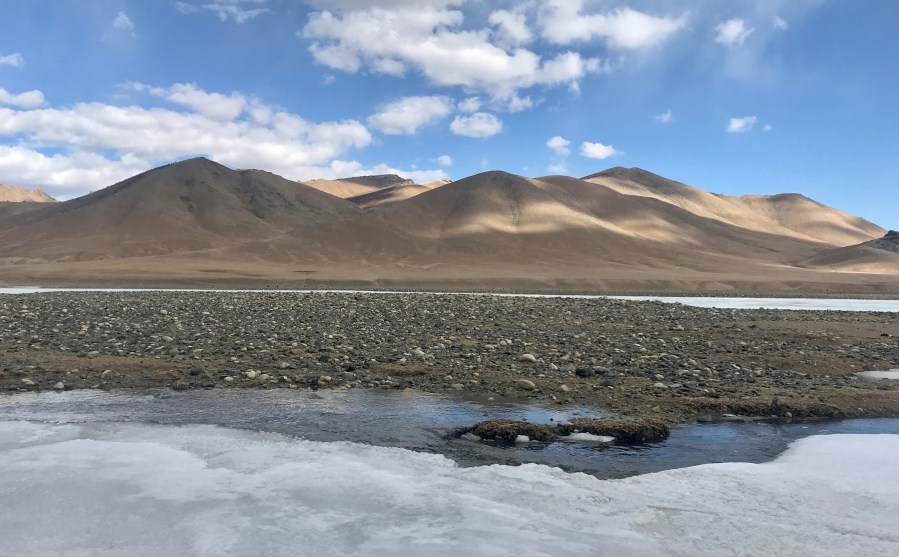
Banner image taken by me in Bayankhongor, Mongolia.
 Tales of a Wandering Ghost