Кыргызская Народная Сказка
A Kyrgyz Folktale
吉尔吉斯民间故事
This folktale is like an Aesop’s Fable about how two anthropomorphized animals deal with moral challenges of survival and empathy. In this story, a hawk nursed a sick owl back to health. After a failed hunt prior to the owl’s recovery, the owl then tried to kill the hawk to eat. This betrayal then led to the hawk killing the owl in self-defense. The story of the The Hawk and the Owl focus on the unintended consequences of the hawk’s altruism in response to the owl’s selfishness and betrayal.
This folktale was written in Kyrgyz and translated into Russian. I translated the Russian text into English and Chinese. The following passages are presented in Russian, English, and Chinese to compare the story and translations paragraph by paragraph. I try to avoid strictly literal (word-for-word) translations in order to better preserve the original literary flow and linguistic elements that are unique to each language. Translation notes and comments are discussed below.
Ястреб и Сова
The Hawk and the Owl
鹰和猫头鹰
Жила-была сова. Однажды она сильно заболела и не могла вылетать из гнезда за пищей. Тогда обратилась сова к ястребу:
— Ястреб-батыр, сделай доброе дело — помоги мне.
Once upon a time, there was an owl. One day she became very sick and could not fly from her nest to get food. Then, the owl turned to the hawk and said:
“Heroic hawk, do a good deed and help me”.
从前,有一只猫头鹰。每当,她生病了,她就无法从窝巢里飞出来获得食物。于是,猫头鹰便头对鹰说:
“英勇的鹰,请为我做些好事吧。帮帮我!”
Согласился ястреб. Он стал кормить больную сову и лечить её. Поправилась сова.
The hawk agreed to the task. He began to treat the owl’s sickness and brought her food to eat. Not long after, the owl recovered.
鹰同意了猫头鹰的请求。他开始治疗猫头鹰的病,并喂给她食物。不久之后,猫头鹰便康复了。
Как-то они вместе вылетели на охоту, но ничего не смогли поймать. И тут сова задумала недоброе. Говорит она ястребу:
— Я хочу есть и потому съем тебя.
— Как же так? — удивился ястреб. — Ведь я тебя выходил, когда ты была больная, я спас тебя от смерти, а ты хочешь ответить злом на добро!
They flew out together to hunt but they were unable to catch anything. And then, the owl was overtaken by unkindness. She said to the Hawk:
“I want to eat….so I will eat you”.
“How will you do so?” said the hawk, surprised. “After all, I was the one who went out when you were unwell. I saved your life and you only want to answer with evil to a good deed!”
他们一起飞出去打猎,但“他们没有捕猎到食物。然后,猫头鹰被邪恶所取代猫头鹰新生之恋。她对鹰说:
“我太饿了。。。所以我要吃掉你呀!”
“你怎么会这样吧?” 鹰惊讶的说。“毕竟, 当你我生病的时候,我陪在你的身边。是我拯救了你的性命但你却想用邪恶来回报善良!”
— Только глупец на добро отвечает добром, — сказала сова. — Разве ты не знаешь, что заботиться нужно только о самом себе!
И сова собралась было кинуться на ястреба. Разгневался ястреб, свернулся комочком и взмыл в небо. Потом, распластав крылья, ринулся вниз и вцепился когтями в неблагодарную сову. Упала сова на землю и тут же испустила дух.
“Only a fool would answer a good deed with a good deed,” said the owl. “Don’t you know that only you can be the one to take care of yourself!”
And as the Owl was about to charge itself at the Hawk. The hawk became angry and curled into itself and soared into the sky. Then, the hawk spread forth his wings and clutched the ungrateful owl. The owl fell onto the ground and there, the owl’s spirit was lost.
“只有傻瓜才会用善良回报善良。” 猫头鹰说。 “你难道不知道只有你自己才能成为照顾自己的人。”
猫头鹰正要冲向鹰,鹰也很生气得卷成一团儿然后飞向天空。紧接着, 鹰又张开了翅膀冲下来他抓紧了那只忘恩负义的猫头鹰。最后,猫头鹰摔到了在地上,她的精神在哪儿消逝了。
Translation notes:
Батыр (Batyr) means hero in Kazakh and Kyrgyz.
When the owl said that she was so hungry, I was caught between deciding whether to use the Chinese phrase 我饿死了 (I’m hungry to the point of death or very hungry) or just 我太饿了 (I’m too hungry). In the context of translating this story, I think that both phrases are equally useful in delivering the same message and moral.
In the end, could it be possible that the moral of this story is that the hawk should have never helped the owl recover and simply let it die? Or, is the moral to never betray someone or else bad things will follow?
What are your initial thoughts concerning the moral of this story?
Cheers,
The Wandering Ghost
Folktale translated from Kyrgyz into Russian from the book, Kyrgyz Folktales (Кыргызские Народные Сказки), published in Bishkek (2018) and compiled by Ledenev Pyotr Grigorevich.
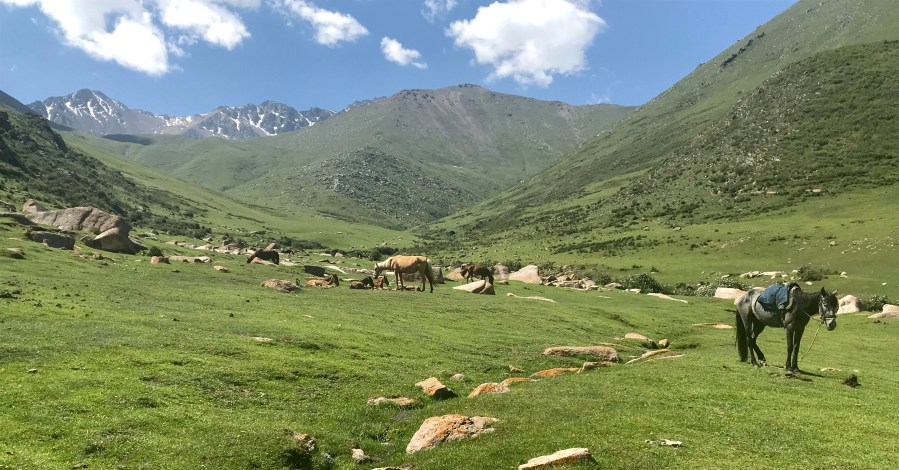
Banner image of horses taken by me near Issyk Kul in Kyrgyzstan.
 Tales of a Wandering Ghost