
子曰。學如不及、猶恐失之。
The Master said, “Learn as if you will never catch up, and as if you feared losing what you already attained.” – Confucius’ Analects (8.17)
If you are a learner of Chinese but find yourself caught within the liminal void between intermediate and advanced reading proficiency, then this post should help you.
I offer a tried and true method that has helped me during my 13 (and counting) years of self-studying Chinese. This method rescued me from the trepidations of lingering self-doubt in my quest to improve Chinese proficiency between levels. This is essentially a liminal void that you need to cross to bridge those natural gaps in knowledge that come about when mastering some areas and falling behind in others. Hopefully, this method can build the stamina to crawl out of those language-learning crevasses with self-confidence and balance.
Reading is a foundational building block for learning vocabulary, grammatical patterns and experiencing new or important colloquial phrases and cultural idiosyncrasies that are commonly unearthed within Chinese texts. Reading guides us into the emotional and cultural voices in and of literature which is why it is so important for language learning.
Opening a Chinese book that is slightly higher than your level of comfort can yield many linguistic delights if you can digest the information at a reasonable pace. You simply can’t live and learn without ingesting all that the language has to offer, linguistically and culturally.
The Italian film director, Federico Fellini once said, “A different language is a different way to see life.” I wholeheartedly agree with this saying, for learning a different language is really like developing another lens to peer at the world through. It gives its learner the skills of obtaining another point of view towards life and how one’s own placement within that society can be perceived.
A significant novel in my studies is Yu Hua’s To Live (活着).
Published in 1993, To Live is a story about a family facing the trials and historical changes of the Cultural Revolution. The novel encompasses the themes of losing one’s riches, civil war, and the endless struggles a family faces during a time of hardship and loss. There is also a film adaptation of this novel directed by Zhang Yimou.
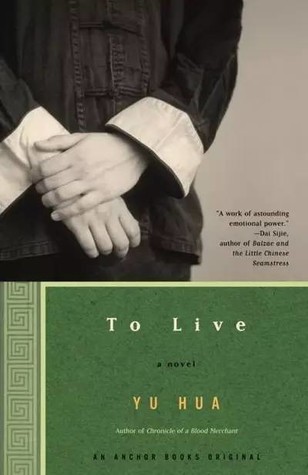
To Live was the first novel I read in Chinese that taught me new vocabulary that wasn’t merely literary but also used in spoken language. The vocabulary, sentence structures, and storyline were helpful as well as captivating. I was never bored while studying this emotional novel about newly emerging modern China.
This novel is flavored by informal northern Chinese colloquialisms and descriptive literary Chinese that built up a compelling tale of history, drama, and angst among its central and peripheral characters. This novel introduced new vocabularies that could be used in many different linguistic contexts.
Below is a method of how to move from intermediate to advanced reading proficiency while also enjoying Chinese literature:
- Purchase or borrow a copy of To Live (or another book of choice).
- As the writer, Robert Louis Stevenson once said, “I kept always two books in my pocket, one to read, one to write in.” Use a notebook to write down the words/phrases you are not familiar with. I typically like to have two notebooks: one for vocabulary, and another for phrases and grammar. Start by reading one chapter or the first few pages during every sitting.
- Highlight new or uncertain vocabularies, grammar structures, and phrases, especially those that are repeated often.
- Reread a chapter or the first few pages of a chapter after studying the material in your notebook.
- Continue this process until you feel more confident in reading without a dictionary, notebook, or app.
- Repetition is the key to mastery, so don’t be afraid to read the novel as many times as you need until you master the vocabulary, grammar structures, and colloquialisms.
- Start another novel with similar linguistically structures or try a slightly harder novel to continue your learning journey.
Other novels I have found helpful for mastering the liminality of comfortable literary advancement include:
- Under the Hawthorn Tree by Ai Mi (山楂树之恋- 艾米)
- Wolf Totem by Jiang Rong (狼图腾- 姜戎)
- Wives and Concubines by Su Tong (妻妾成群- 苏童)
- Fortress Besieged by Qiang Zhongshu (围城- 钱钟书)
- Red Poppies by A Lai (尘埃落定- 阿来)
- Abridged versions of Strange Stories from a Chinese Studio (聊斋志异) by Pu Songling (蒲松龄) are also fun to read. Some of my favorite stories from this collection of Chinese ghost stories is Yaksha Country (夜叉国) and Painted Skin (画皮).
- Any book by Eileen Chang (张爱玲) and Qiong Yao (琼瑶) is a great read. They are romantic in a way that heightens my inner Jane Austen.
I highly recommend reading books that were originally written in Chinese in order to get a better sense of the language and cultural holism. Reading translated books can be useful but they likely will not provide the clearest view into the culture and literary history embedded in a native novel. I find that reading books written in Chinese helped me with idioms that are specifically tied to the language, culture, and era of the people who wrote them.
Chinese is a truly remarkable language to learn. I often tell people that studying Chinese language and culture has been etched into my heart and bones, therefore, unforgettable.
Idiom: 刻骨铭心 (kè gǔ míng xīn)
Translation: Carved in one’s bones, etched in one’s heart
The layers of wisdom, literary richness, abundance of characters, and even some of the cultural idiosyncrasies followed by historical memory are all something stays within you forever. It can eventually become a part of what makes you the person you are today. This is what makes Chinese such a rich and intriguingly beautiful language to learn today.
I hope this post brings confidence and fulfillment in your journey toward advancing Chinese.
Cheers,
The Wandering Ghost Girl
Banner image taken by me in Jiufeng, Taiwan.
 Tales of a Wandering Ghost