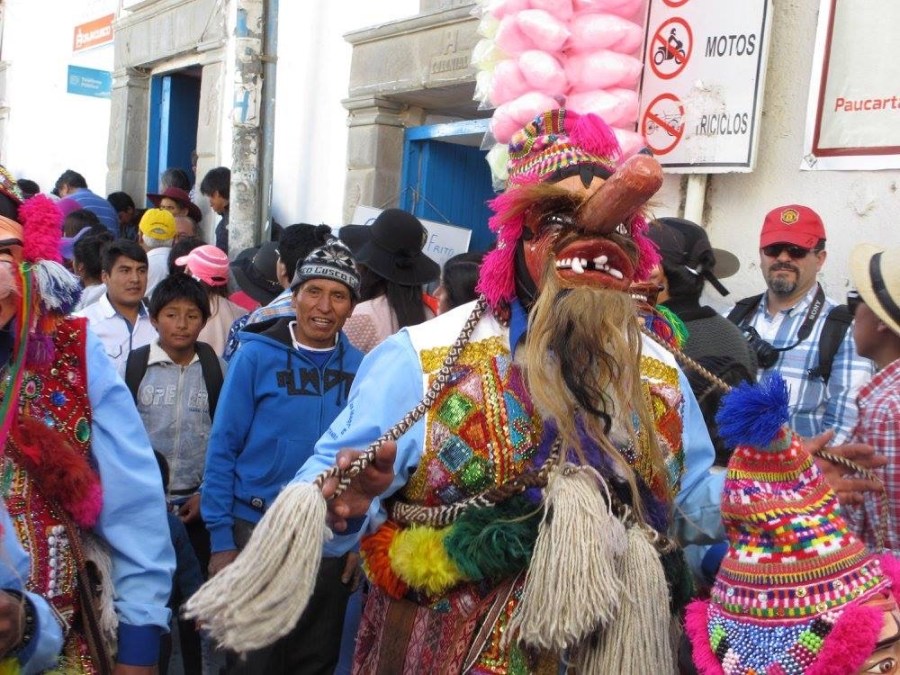
Rituals, costumes, and customs play synergetic roles in the development and maintenance of cultural norms. Celebrations are events where these roles coalesce to create and extend the bonds of tradition among neighbors and across generations. Festivals like the Mamacha Carmen allow locals and visitors alike to experience local customs and how the community celebrates their similarities and respects their differences.
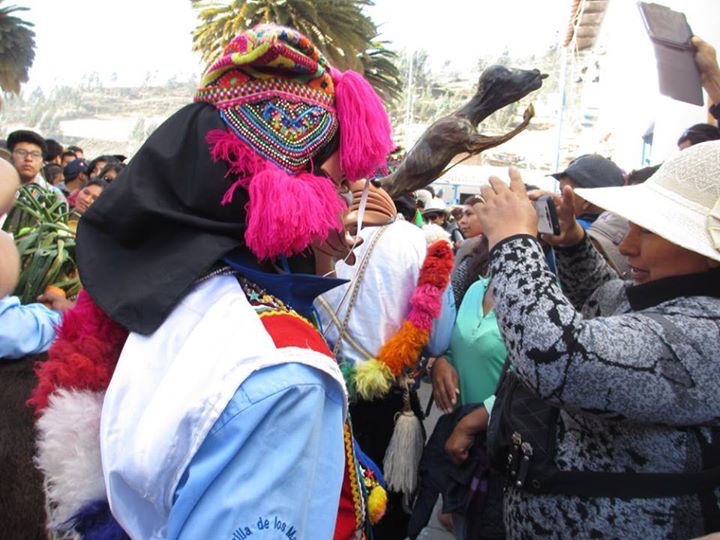
The Mamacha Carmen or Festival of the Virgin Carmen is one of the Peru’s most widely recognized festivals. It is famous for how it bridges indigenous and mestizo identity into a creative ritual of mocking neighboring tribes and remembering the remains of Spanish conquest.
Since the arrival of the Spanish in Perú during the early 1500s, Catholicism spread; with it came a differentiation of ethnic identities into castes. The Spanish historian, Bartolomé de Las Casas, wrote in his essay, In Defense of the Indians, that the Spanish observed the Incas as “savage” and that the only way to change them was to spread the teachings of the Catholic faith.
Back then, it was widely thought that strict enforcement of the teachings of Catholicism upon indigenous Andeans was the best strategy for occupying the region without war; however, this strategy ultimately proved to be incorrect. During this time, the Spanish forced their language, culture, and creed upon the local inhabitants, eventually bringing about war and the downfall of the once great Inca empire.
The aftermath of the Spanish conquest still exerts a powerful influence on the class divisions among Peruvian ethnic groups. For example, the term “mestizo” describes a person that is a blend of Indian and Spanish ancestry. This term was used to label any Peruvians throughout the region of Cuzco, which was the capital city of the Inca Empire before Spanish dominance.
During the Spanish conquest, the mestizo identity is a hybrid of indigenous and European cultures; however, in this mixture, Spanish ancestry did not bring with it any significant social benefits. In fact, the mestizo class demonstrated the power of the Spanish purity over bloodlines, familial ties, and cultural upbringing that echoes through the history of Perú.
Other ethnic identities within the region were labeled as White, Indian, and Cholo; however, the identity of being White indicated a person fully comprised of Spanish ancestry whereas the term Cholo is identified the same as a mestizo individual but labeled with more negative connotation.
Music and Dance Fundamentals in the Andes
Music and dance are displays of cultural and ethnic distinctions that have shaped Andean communities around the Cuzco region. These are physical expressions of how history, hierarchy, and tradition has anchored new generational shifts with traditions, rituals, and customs that ultimately preserve indigenous practices while also incorporating Spanish influences.
Many Andean festivals celebrate the cultural union and differences among Indians and mestizos. These festivals provide a vital link to the past, and continue to provoke questions that shape the ideas about what is authentically Andean through dance and music.

Before the arrival of the Spanish, music in the Andes relied heavily on wind instruments, such as the pan flute, and dances were reserved for religious and political purposes (Poole 1990). After the Spanish colonial period ended in Perú (1824), the hybridized identity of mestizos gradually become incorporated into the ritual dances and musical styles of the region. These dances evolved into their own hybrid of Indian and mestizo identity, finally blending into a single cultural form that is now celebrated by all.
Today, many of the ritual dances include mestizo-identifying individuals who participate in traditional indigenous rituals while idolizing a Catholic patron saint. In Andean communities, each dance can be considered an expression of cultural and class distinctions intersecting with ethnic identity, history, and those imposed by modernity brought by increased tourism in Perú. These distinctions question “what is authentic?”
Bibliography:
Authier, Martine du. 2009. Fiesta Andina: Mamacha Carmen en Paucartambo. Lima: San Marcos.
Mendoza, Zoila S. 2000. Shaping Society through Dance: Mestizo Ritual Performance in the Peruvian Andes. Chicago: University of Chicago Press
Poole, Deborah A. “Accommodation and Resistance in Andean Ritual Dance.” The MIT Press, vol. 34, no. 2, 1990, pp. 98-126.
Romero, Raul. R. Debating the Past: Music, Memory, and Identity in the Andes. New York: Oxford University Press, 2001.
The Peru Reader: History, Culture, and Politics, ed. By Orin Starn, Carlos Iván Degregori, and Robin Kirk. London: Duke University Press, 119-122, 2005
Banner image taken by me in Paucartambo, Peru.
 Tales of a Wandering Ghost